

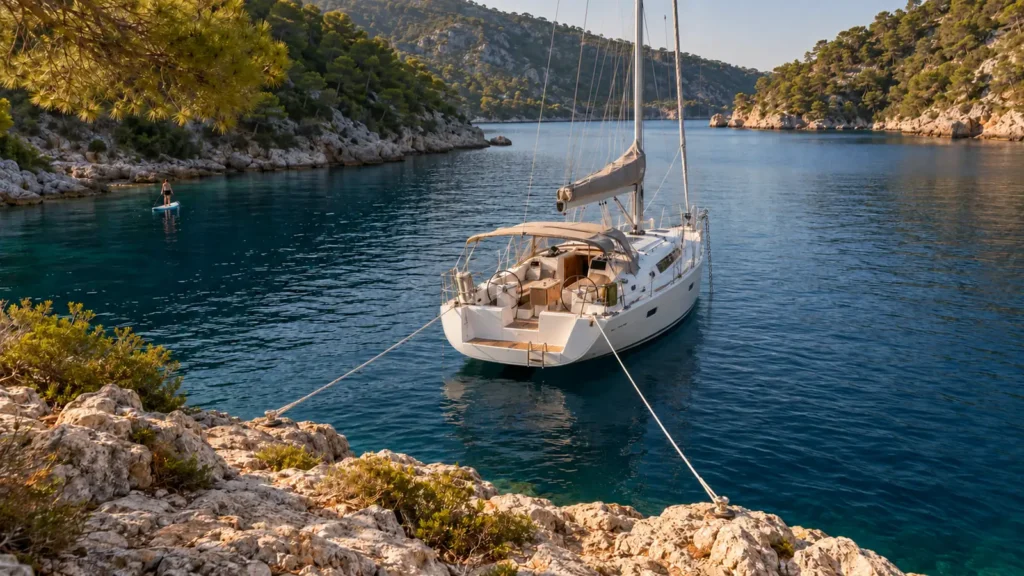
In Greece, Croatia and the Balearics, many of the best anchorages are too deep or too tight to swing freely. The answer is to drop your anchor, back towards the shore and hold the stern with two lines tied ashore. If you are learning how to tie stern to rocks, the good news is that it is a simple system. Rings and bollards are used too, but most of the time it means rocks. Once you know the order of jobs, it works the same whether you have eight people on board or two. We have done it for years sailing two-handed in Greece and Croatia.
And if your first attempt involves a bit of shouting, a rope that is somehow too short and a crew member waving from a rock, you are in good company. Everyone’s first time looks a little silly. This guide is about making the next one look calm and confident, from the cockpit to the shore, and then sleeping well once you are tied up.
Why tying stern to rocks works
Tying stern to rocks keeps the boat still. Instead of swinging around the anchor, you sit in one place with the bow pointing out of the bay and the stern held by lines ashore. That lets boats fit into small, sheltered spots close to the rocks where swinging would be impossible.
The process is basically the same across the Mediterranean, with some local rules in certain areas. Always follow local signage and rules on where you may anchor and tie on.
Choosing the right spot
- Other boats already tied to shore. Lots of boats tied back is a good sign. It tells you the spot works and people have done it before.
- Enough depth for your draft. Check the chart. Most Greek bays are 3 to 4 m deep right up to the rocks, or within about 10 m of them. That is fine for a motorboat drawing 1 m, but not for a yacht drawing 3 m. Our rule is about a metre under the keel, plus extra if there is swell. Near a ferry route, the wash can throw up half a metre.
- Shelter from the current wind. Choose a bay that is not open to the direction the wind is blowing from now, and check the forecast for a shift overnight. Our guide to what happens when the wind changes direction at anchor explains why that matters.
- Bottom type. This matters less than you might think. Focus on depth and shelter, and put out plenty of chain.
For ideas on where to try it, see our best anchorages in Greece.
What you need
- Two shore lines, usually at least 50 m each, flaked out and ready to run freely.
- A chain or strap for the rock. Tie your line to a chain or strap around the rock rather than to the rock itself. Chain at the rock stops the line chafing and lifting off as the boat moves.
- A dinghy or, ideally, a paddleboard. A paddleboard is quicker through the water and easier to handle close to rocks.
- Plenty of anchor chain. More on that below.
- A way to watch the anchor. A Morphéis GPS anchor buoy is attached to your anchor by its trip line, so it marks and tracks the anchor itself.
What to tie to
- Rocks. A solid rock with a chain or strap around it is the most common option and usually the best. Check the rock underwater as well as above, because a sharp edge just below the surface can chafe through a line.
- Rings or bollards. Where they are provided, use them.
- Trees. You will see people do this, but many countries and municipalities around the Med do not allow tying to trees, and if you get caught you can be fined. It is not worth it. Always check the local rules and look for a rock instead. Ideally that is one above the water, but if not, there are usually plenty of options just under the surface too.
Crew roles
You only need two people: one ashore and one on the boat. Charter crews often have six to eight people on board, while shorthanded crews might have two or three. The process is the same either way. A simple system beats numbers, and a crew of two who know the order of jobs will tie up more calmly than a crew of eight all trying to help at once.
- The shore person takes the lines ashore by paddleboard or dinghy and ties them on.
- The helm drops the anchor, reverses the boat and controls the windlass.
Agree the plan and hand signals before you start, because it is hard to hear over the engine and windlass. And never try to clear a chain jam at the windlass with your fingers (Motor Boat & Yachting).
How to tie stern to rocks, step by step
The key idea is simple: the shore line goes ashore first, before the anchor goes down.
- Work out which side is windward. The windward line always goes on first. If the wind is coming from port, your port line goes ashore first. The RYA gives the same windward-first rule for stern lines in its stern-to guidance.
- Send the shore person in first. Before you drop anchor, the shore person takes the windward line ashore on the paddleboard or in the dinghy, puts the chain or strap around the chosen rock and ties the line on.
- Paddle out with the whole line. With the line tied to the rock, the shore person paddles out with the whole line uncoiled, say 50 m, and waits about 30 to 40 m offshore holding the end. There is no fixed distance for the boat itself: get as close in as you can for shelter, but go out as far as you need for depth. If it is only 2 m deep 10 m off the rocks, sit at 20 m.
- Drop the anchor. Line the boat up with the shore person and drop the anchor well out, with the Morphéis buoy’s trip line attached so it goes down with the anchor. Pay out chain as you go.
- Reverse and meet in the middle. Back gently towards the shore person, who hands the windward line up to the boat. Because they are well out, the crew has time to cleat it while the boat keeps reversing another 10 to 20 m. That takes away a lot of the stress. Waiting at the back of the boat instead is fine only if you are not short-handed. Once the windward line is back on board, you are safe. Nothing needs to happen quickly from here.
- Keep everything slack. Do not tighten yet. Slack lines and chain make the next job easy.
- Run the leeward line. Hand the leeward line to the person in the dinghy or on the paddleboard. They take it ashore, put the chain or strap around a second rock and tie it on.
- Tighten up and set the anchor. Take the slack off both aft lines and tighten the anchor chain with the windlass until the boat sits square, off the rocks. Then put the snubber on and ease the slack off the windlass, so the snubber, not the windlass, takes the load.
The biggest problem: not enough chain
The most common problem is simply not putting out enough anchor chain. Many of these bays get deep a short way off the shore, so the anchor goes down well out from the rocks. Put out as much chain as your boat has, or close to it. Most boats carry at least 50 to 60 m, and in some countries up to 100 m. The wind usually hits you from the side when you are tied to the rocks, so the anchor takes a sideways load, and more chain helps it hold. More chain also makes it less likely that someone else picks up your anchor with theirs. Our guide to how much anchor chain to let out explains how depth changes the amount you need, and our guide to common Mediterranean anchoring mistakes covers the others we see most.
The Morphéis buoy sits on the surface above the anchor, so you and your neighbours can see where your anchor lies. That makes it easier for others to keep their chain clear of yours.
The biggest mistake to avoid
The classic mistake goes like this. The boat drops anchor, reverses in, and then someone jumps off the back and tries to swim the rope ashore. They are swimming against the wind and current, towing a heavy line, while the boat swings towards the neighbours. It is stressful for everyone, and it is how boats end up touching.
Getting the shore line ashore first avoids all of that.
How to leave
Leaving is the same process in reverse, with one rule: the person ashore needs slack to untie each line.
- Leeward line first. The shore person unties the leeward line from the rock, and the crew brings it right back aboard, so only one line is ashore.
- Stay in reverse. Keep gentle reverse on so the windward line stays slack. The shore person lifts it off the rock and the crew pulls it in.
- Line aboard, then go. Once the windward line is out of the water and in the cockpit, either motor gently forward or go to neutral and let the anchor’s pull slowly swing you forward. Then lift the anchor.
- Pick up the shore person. They paddle or take the dinghy out and get back aboard when they can.
You can double the windward line back to the boat, running it around the rock and back so it can be released from on board. It is possible but uncommon, because the line can snag on the rock as you pull it through. Having someone ashore to untie each line is usually better.
Anchor alarms when you tie stern to rocks
A normal anchor alarm on your boat, phone or laptop watches the position of the boat. When you swing freely, that works, because if the anchor drags, the boat moves.
When you tie stern to rocks, the lines hold the boat in place. It barely moves, even if the anchor is dragging out in the bay. A boat based alarm has very little to measure, so it cannot tell you much.
A GPS anchor buoy watches the anchor itself. The Morphéis buoy floats on the surface above your anchor and tracks its position to about 4 m, then alerts you on board through its dedicated receiver. With a SIM card you supply, it can also send SMS alerts when you are ashore. It is an aid to seamanship, not a replacement for it. Our guide to anchor monitoring systems compares the options, and if the worst happens, here is what to do if your anchor drags.
It has genuinely made life onboard so so much more less stressful. Especially when a random storm comes in from the wrong direction during the middle of the night.
— Peter, verified owner review of the Morphéis GPS Anchor Buoy
I own a Beneteau Oceanis 52, and Morphéis is exactly what I needed to feel more confident and secure while at anchor. Highly recommended!
— Mario, owner review of the Morphéis GPS Anchor Buoy
Frequently asked questions
Can two people tie stern to rocks?
Yes. You only need one person ashore and one on the boat.
Which line goes on first?
Always the windward line. If the wind is from port, the port line goes ashore first.
How long should my shore lines be?
Usually at least 50 m each.
Is a paddleboard better than a dinghy?
Usually, yes. It is quicker through the water and easier to handle close to rocks.
Is this the same as Med mooring on a quay?
No. On a town quay or in a marina you reverse onto the wall and use lazy lines or your own anchor. The RYA’s stern-to guide covers that, and Yachting Monthly has good tips on handling lazy lines.
Settle in and enjoy the bay
Tying stern to rocks comes down to a simple order: shore line first, windward before leeward, plenty of chain and everything slack until both lines are on. Do that and it becomes routine, whatever the size of your crew.
Once you are tied up and looking suitably relaxed, the last thing you want is to lie awake wondering whether the anchor is holding. Clip a Morphéis GPS Anchor Buoy to your anchor before it goes down and it will keep watch on the anchor itself, so you can sleep easier and enjoy the bay. For more on that, read how to sleep better at anchor.