

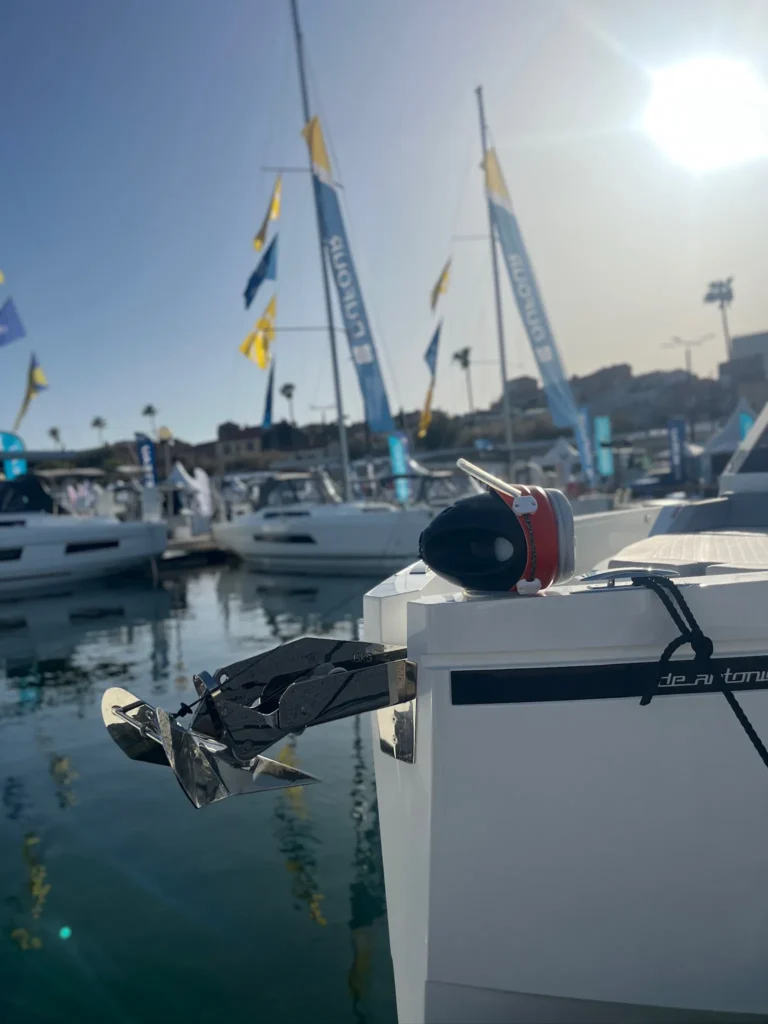
How to Choose the Best Anchor for Your Boat
Ask five experienced sailors to name the best boat anchor and you may receive five different answers.
One skipper has spent years anchoring in Mediterranean sand. Another regularly encounters weed. A third is crossing tidal rivers with frequent reversals. Their boats have different windage, bow rollers, windlasses and cruising plans.
It is therefore more useful to ask a slightly different question:
What is the best anchor for my boat, my cruising area and the conditions in which I expect it to hold?
Modern anchors from manufacturers such as Rocna, Mantus Marine, Spade, Viking Anchors and Knox Anchors all approach setting, burial, holding and resetting through their own design decisions.
If you normally cruise in the Mediterranean, anchor choice should also be considered alongside the local techniques and conditions covered in our guide to common Mediterranean anchoring mistakes.
This article does not attempt to declare one of them the universal winner. There is no honest way to do that without specifying the boat, seabed, weather, installation and test conditions.
Instead, it explains how to make a sensible choice—and why even an excellent anchor is only one component of a dependable anchoring system.
The short answer
The best anchor is one that:
- is correctly sized for your boat and intended use;
- suits the seabeds in which you normally anchor;
- fits and deploys correctly from your bow;
- can be handled by your windlass and ground tackle;
- sets reliably with the scope available;
- behaves predictably when the direction or strength of load changes.
Brand and design matter, but so do chain, rode, shackles, the snubber or bridle, windlass, anchoring technique and monitoring.
A premium anchor attached to an unsuitable or poorly deployed system can still fail to hold. A complete system gives every component the best chance to do its job—and gives the crew early warning if circumstances change.
Start with the boat, not the brand
Manufacturer sizing tables are the sensible starting point, but boat length alone does not describe the complete load on an anchor.
Consider:
- Loaded displacement: Use the boat’s realistic cruising displacement, including fuel, water and equipment.
- Windage: A catamaran, deck-saloon yacht or motor cruiser can present considerably more area to the wind than a low-profile monohull of similar length.
- Intended use: A lunch stop in settled weather is different from regular overnight anchoring or long-term cruising in remote areas.
- Expected conditions: Tidal reversals, squalls, strong currents and exposed anchorages all affect the duty expected of the ground tackle.
- Available handling equipment: The anchor, chain and connectors must work with the bow roller, windlass and crew.
If your boat sits near the boundary between two sizes, ask the manufacturer for guidance. Many long-distance cruisers choose additional margin, but simply buying the heaviest anchor that will physically fit is not a substitute for considering the entire installation.
Match the anchor to the seabed
Anchors develop holding power by engaging with the seabed. That makes the bottom beneath the boat at least as important as the steel hanging from the bow.
Sand
Sand can provide excellent, predictable holding when it is deep enough for the anchor to bury. Hard-packed sand may require good penetration; very soft sand may require more fluke area to develop resistance.
Mud and clay
Mud ranges from firm and cohesive to extremely soft. Some anchors penetrate easily but need time or distance to develop holding power. Sticky material can also build up around parts of an anchor and affect a subsequent reset.
Weed and grass
The anchor must penetrate the vegetation and engage with the material below. A set can feel convincing initially even if the fluke has collected weed rather than buried securely.
Gravel, stones and rock
In non-penetrable ground, an anchor may depend more on finding a secure feature than on normal burial. Results can be less predictable, and a design that excels in sand or mud cannot make featureless rock into good holding ground.
Charts, pilot books and local knowledge can help identify the general bottom type, but conditions may vary significantly across a single anchorage. Always confirm the set rather than relying on the chart description alone.
Location guides can help turn these principles into practical decisions. For example, our guide to the best anchorages in Greece and how to stay secure overnight considers the relationship between shelter, local conditions and anchoring security.
Five modern anchor manufacturers worth researching
The following are not rankings. They are established anchor options whose official information, sizing recommendations and fit guidance are useful when assembling a shortlist.
Rocna
Rocna Anchors offers designs including the Rocna and Vulcan. The company provides a detailed knowledge base covering sizing, bow compatibility, materials, setting and retrieval.
When considering a Rocna, use the manufacturer’s current size chart and check the geometry against your bow roller and pulpit. The appropriate model may depend as much on bow compatibility as on the size of the boat.
Mantus
Mantus Marine offers its M1 and M2 anchor families, along with related anchoring equipment. Its product information places particular emphasis on initial penetration and performance across challenging bottom types.
As with any roll-bar or non-roll-bar design, confirm both the recommended size and the physical fit on the boat before purchasing.
Spade
Spade uses a concave fluke and weighted tip, with anchors available in galvanised steel, stainless steel and aluminium. Its sizing tool allows owners to search by boat or product characteristics.
Material affects weight, handling, cost and intended use, so compare the manufacturer’s guidance rather than assuming two visually similar sizes are interchangeable.
Viking
Viking Anchors produces lightweight, high-tensile steel anchors and highlights penetration, resetting and power-to-weight ratio in its design information. A detachable shank is also available on its Viking model for storage.
Weight saving can be attractive for manual handling or reducing weight at the bow, but selection should still follow Viking’s sizing guidance and the loads expected from the boat.
Knox
Knox Anchors uses a divided-fluke design developed through testing in Scotland. Its published material focuses on burial behaviour, controlled movement under increasing load and performance when the direction of pull changes.
Knox provides sizing and bow-fit guidance based on factors including displacement, windage and intended anchoring profile. As with the other manufacturers, use the current manufacturer recommendation for your particular boat.
Do not compare headline holding numbers without context
Anchor tests can be valuable, but the result depends on the test.
Before treating a number as definitive, ask:
- What type and consistency of seabed was used?
- Was the anchor given enough distance to set fully?
- Was the load applied steadily or dynamically?
- Was the result peak load, sustained load or distance dragged?
- Were all anchors comparably sized by weight, surface area or manufacturer recommendation?
- Was resetting after a directional change tested?
- Is the test representative of how the anchor will be used on your boat?
An anchor can perform extremely well in a repeatable straight pull, yet your real concern might be resetting in a tidal river. Another owner may care more about penetrating weed, fitting beneath a bowsprit or handling the anchor without a windlass.
The right question is not simply, “Which anchor produced the biggest number?” It is, “Which evidence is relevant to my boat and the places where I anchor?”
Think about how the anchor behaves when conditions change
An anchor is not merely holding or not holding. Several things can happen as wind, current and load change:
- it can remain buried and rotate towards the new load;
- it can move a short distance and reset;
- it can continue to bury or plough through the seabed;
- it can break free, become fouled or fail to re-engage promptly.
Different anchor geometries are intended to manage these behaviours differently. Seabed conditions can change the outcome, however, and no anchor design can guarantee the same result in every situation.
This matters most after a significant wind shift or tidal reversal. The anchor may have set perfectly in the original direction but is now being loaded from the side or from behind.
For a detailed explanation, read what happens when the wind changes direction at anchor.
The best anchor is not the complete anchoring system
Once you have selected an appropriate anchor, it needs the rest of the system to perform correctly.
Chain and rode
The chain, rope and connectors must be correctly sized, compatible and maintained. The rode also needs sufficient length for the depths and conditions in which you cruise.
Scope
Adequate scope keeps the direction of pull closer to horizontal and helps the anchor remain buried. Scope must account for water depth, tidal rise and the height of the bow roller above the water—not just the number shown on the depth sounder.
Our practical guide to anchor scope explains the calculation in more detail.
Snubber or bridle
On an all-chain rode, a nylon snubber can absorb shock loads and transfer strain away from the windlass. A catamaran bridle also helps centre the load and can improve how the boat lies at anchor.
Windlass and bow installation
The windlass should retrieve the ground tackle, not be relied upon as the sole point carrying anchoring loads. Check the bow roller, chain stopper, attachment points, shackles and clearances as a system.
Technique
Choose adequate swinging room, lower the anchor under control, deploy sufficient rode and verify the set. No equipment compensates for dropping onto unsuitable ground or failing to test whether the anchor has engaged.
Monitoring
Finally, you need a reliable way to know whether the anchor remains where it was set.
This is the component that is often missing.
For a fuller comparison of the available approaches, see our guide to the best anchor alarms for boats, from apps to dedicated systems.
No anchor can remove every uncertainty
A well-designed, correctly sized anchor can provide enormous confidence. But it cannot control the weather or guarantee the nature of the seabed.
The wind may increase beyond the forecast. A squall may reverse the direction of load. The anchor may have caught weed, or a thin layer of sand may conceal rock. Another boat may force you to use less scope than you would prefer. The anchor may reset immediately—or it may not.
When conditions deteriorate, the most useful question is no longer which anchor won a comparison. It is:
Is my anchor moving now?
Most phone and chartplotter anchor alarms monitor the GPS position of the boat. But a securely anchored boat is supposed to move as it swings around its anchor. The alarm therefore relies on an estimated anchor position and a radius large enough to accommodate normal movement.
A tight radius can produce nuisance alarms. A wide radius can delay the warning.
That uncertainty is one of the main reasons skippers repeatedly check their position overnight. Our guide to sleeping better at anchor without constantly checking explains how preparation, observation and dependable monitoring work together.
Morphéis completes the system by monitoring the anchor itself. Its GPS buoy remains above the anchor and communicates directly with a dedicated onboard receiver. Normal swinging of the boat does not need to be interpreted as anchor movement; if the anchor itself changes position beyond the system’s tolerance, Morphéis alerts the crew.
It does not compete with Rocna, Mantus, Spade, Viking, Knox or any other anchor. It answers a different question that applies to all of them.
You choose the anchor that best suits your boat. Morphéis helps you know whether that anchor is still holding when the conditions change.
Discover Morphéis and build a more complete anchoring system